Livewire vs Alpine.js in 2026: the line is the same (here's how to draw it)
TL;DR
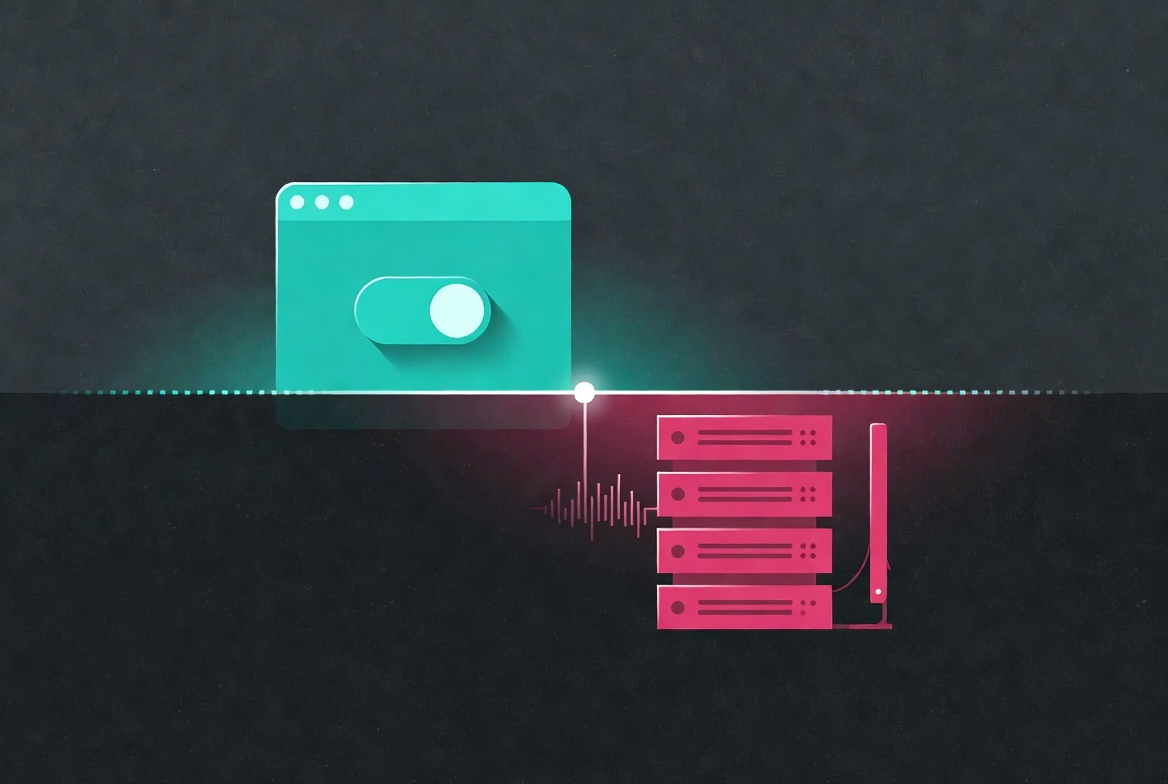
Alpine for anything that lives entirely in the browser — menus, toggles, tabs. Livewire for anything that needs the server — search, forms, persisted state. They nest: Livewire owns the data, Alpine owns the UX around it. By 2026 the line still hasn't moved.
**When you're building a feature — a dropdown, a search box, a form — the first question is often: Alpine or Livewire? **
Here's the mental model I use: Alpine handles anything that lives and dies in the browser. Livewire handles anything that needs to talk to the server. Everything else is deciding which side of that line your interaction falls on.
The confusion is real because both belong to the TALL stack and both work through declarative HTML attributes. But they solve different problems. Alpine is JavaScript you don't have to write — it runs entirely in the browser, no network request involved. Livewire is server-side state with DOM diffing — your PHP component owns the truth, and the browser just renders what the server decides. An Alpine dropdown opens and closes in memory. A Livewire search hits the database and comes back with HTML for the changed parts of the page. Same look to the user, completely different operations under the hood.
When I reach for Alpine, the server isn't needed to make a decision. A mobile menu toggle, a theme switcher, a tab group — anything where the answer already exists on the client. That dropdown that just opens and closes? Alpine. Zero request, instant, no round-trip.
<div x-data="{ open: false, dark: false }">
  <button @click="open = !open">Menu</button>
  <div x-show="open" x-transition>
    <button @click="dark = !dark">Toggle dark mode</button>
  </div>
</div>
When I reach for Livewire, the server is the authoritative source. A search that queries the database. A form that validates and saves. A counter that persists across sessions. Filament's entire admin panel is Livewire — because the database is the source of truth. Here's a complete search, not a stub.
<input
  type="search"
  wire:model.live="search"
  placeholder="Search users..."
>

<div wire:loading>
  Searching...
</div>

<ul>
  @foreach ($users as $user)
    <li>{{ $user->name }}</li>
  @endforeach
</ul>
use Livewire\WithPagination;

class SearchUsers extends Component
{
    use WithPagination;

    public string $search = '';

    public function updatedSearch(): void
    {
        $this->resetPage();
    }

    public function render()
    {
        return view('livewire.search-users', [
            'users' => User::query()
                ->where('name', 'like', "%{$this->search}%")
                ->paginate(10),
        ]);
    }
}
Every keystroke fires a request, the query runs, and only the changed parts of the DOM get swapped in. That's the round-trip you're buying.
The trap to avoid is reaching for Livewire when Alpine would do. Putting wire:poll on an open/close animation means you're hitting the server for something the browser can do itself — an expensive way to avoid writing ten lines of JavaScript. And the reverse is just as bad: pushing server state into Alpine (a dropdown reading from a PHP variable that never changes after load) is duplicated state waiting to bite you the moment the source of truth moves.
Where it gets interesting is nesting the two. Take the search above and make the dropdown itself Alpine-powered — Livewire fetches the data, Alpine handles the keyboard navigation and the open/close feel. They stop being competitors and become two layers of the same component.
<div
  x-data="{ open: false, highlighted: 0 }"
  @keydown.down.prevent="highlighted = Math.min(highlighted + 1, {{ $users->count() - 1 }})"
  @keydown.up.prevent="highlighted = Math.max(highlighted - 1, 0)"
>
  <input
    type="search"
    wire:model.live="search"
    @focus="open = true"
    @blur="setTimeout(() => open = false, 150)"
  >

  <ul x-show="open" x-transition>
    @foreach ($users as $i => $user)
      <li
        @mouseenter="highlighted = {{ $i }}"
        @click="$wire.select({{ $user->id }})"
        :class="highlighted === {{ $i }} ? 'bg-gray-100' : ''"
      >{{ $user->name }}</li>
    @endforeach
  </ul>
</div>
Livewire ships with Alpine bundled and exposes $wire inside it, so calling into the component from the client is a first-class move: $wire.select(id), $wire.set('search', value), $wire.users. You're not patching two libraries together — nesting is the designed default, not an exception you have to justify. One production note: dropping Blade variables straight into x-data like I did above works fine, but the DOM gets re-generated on every Livewire render. If the Alpine state outlives that, keep it on the Alpine side and let Livewire only supply the data — that's the cleaner split on a real component.
The line does blur in one place worth calling out: optimistic UI. If you want a checkbox to flip instantly and only sync with the server in the background, that's an Alpine interaction betting on Livewire to follow through. If the value has to be validated and stored before the UI can trust it, that's Livewire territory. Validation is the clearest case — real-time client-side checks via Alpine for feel, authoritative server-side validation via Livewire on submit. Same interaction, two layers, each doing what it's good at.
Has anything changed in 2026? Not fundamentally. Livewire v3 and v4 and Alpine v3 still draw the same line, and the philosophy in the Livewire docs — Alpine for the client side, Livewire for anything that touches the server — holds. What improved is the friction between them: with $wire and the bundled Alpine, the seams are nearly invisible.
Here’s the practical rule I follow 80 % of the time: if the interaction has to talk to the server to be correct, Livewire. If it can resolve entirely in the browser, Alpine.
TL;DR: Alpine for anything that lives entirely in the browser — menus, toggles, tabs. Livewire for anything that needs the server — search, forms, persisted state. They nest: Livewire owns the data, Alpine owns the UX around it. By 2026 the line still hasn't moved.
**Where do you draw the line in your own projects — and what's the one thing you've built that made you question it? **

About the author
HappyToDev
Hello it's Fred, but you know me more by my nickname : HappyToDev.
My bio
Husband and twice dad 💪
Ex of the French Navy 🫡
I've been passionate about IT since I was 10, and code is in my blood. I'm always up for a laravel new 😉
Newsletter creator 🗞️ :
Framework Heroes creator 🦸🏽♀️🦸🏻♂️
I've been wanting to create this site for several months to create a job board specialising in devs using frameworks. I hope you like the concept and that you'll help me develop it by contributing new ideas.
Comments ()
No comments yet. Be the first to comment!